Composer of the Month 4/2014: Jean-Philippe Rameau
(selected by Peter van Dessel / Belgium)
 France 9.7.1953
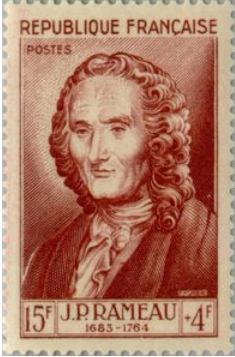
|
de Negri, Karolina Blixt and the orchestra "Les Arts Florissants" under the direction of William Christie. |
|
The French composer and music theorist Jean-Philippe Rameau was christened on 25 September 1683
in Dijon. He received his first musical training from his father, an organist. As a young man he
worked in various cities as orchestral violinist and organist. In 1722 he settled in Paris, where
soon afterwards he published his first theoretical work. He gained an excellent reputation as a
music theorist. A work published in 1726 is the basis for the modern chord and harmony.
Around 1727 he met his patron, the general tax minister of King Louis XV. invited Rameau and his family to live in his palace. For twelve years, Rameau led his private orchestra. In 1733, after several failures, Rameau succeeded to perform his opera drama "Hippolyte et Aricie". From Louis XV. he was then elevated to the peerage and appointed "cabinet composer". Besides his dramatic works (operas, ballets, cantatas) Rameau created instrumental works, especially chamber music for harpsichord solo. Especially known are the "Pièces de clavecin en concert" for harpsichord, violin and viol. Despite his reputation as a great French musician, Rameau's lyrical work after his death became into oblivion. Only in the 20th Century his works found their way back to the stage and are now part of the repertoire of well-known baroque ensembles. Jean-Philippe Rameau died on 12 September 1764 in Paris. 2014 is the 250th anniversary of his death. More composer can be found in the members only section |