Andrew Fletcher was born in Nottingham on July 8, 1961. He first played electric bass and was a member of the group “No Romance in China” with his school friend Vince Clarke. In 1979 he switched to synthesizers and formed the band “Composition of Sound” together with Clarke and Martin Gore. The band was later renamed “Depeche Mode”.
“Depeche Mode” is considered the most popular synth rock and synth pop group. With over 100 million records sold worldwide, it is one of the most successful bands in the world. Andrew Fletcher was the only member of the band who never wrote a song. As the band’s keyboardist, however, he had a decisive influence on the band’s style. In addition, he took on many of the organizational tasks and was heavily involved in the band’s studio work.
Category: Stamps
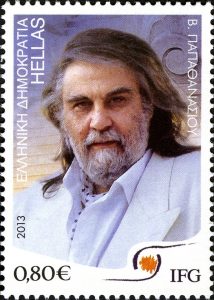
In Memoriam: Vangelis

New Stamps 2021
Every year, worldwide more than 200 stamps related to music are issued. The list of new issues published in the members-only-section of our website is updated several times per month.

6.3.: Angola / Central African Republic / Chad / Colombia / Djibouti / Mocambique / Sao Tomé / Togo / Turkmenistan
24.3.: Chad / Djibouti
13.4.: Albania / Central African Republic / Chad / Philippines / Uzbekistan
7.5.: Andorra / Guinea-Bissau / Paraguay / Sao Tomé
Stamp of the Month: May 2022
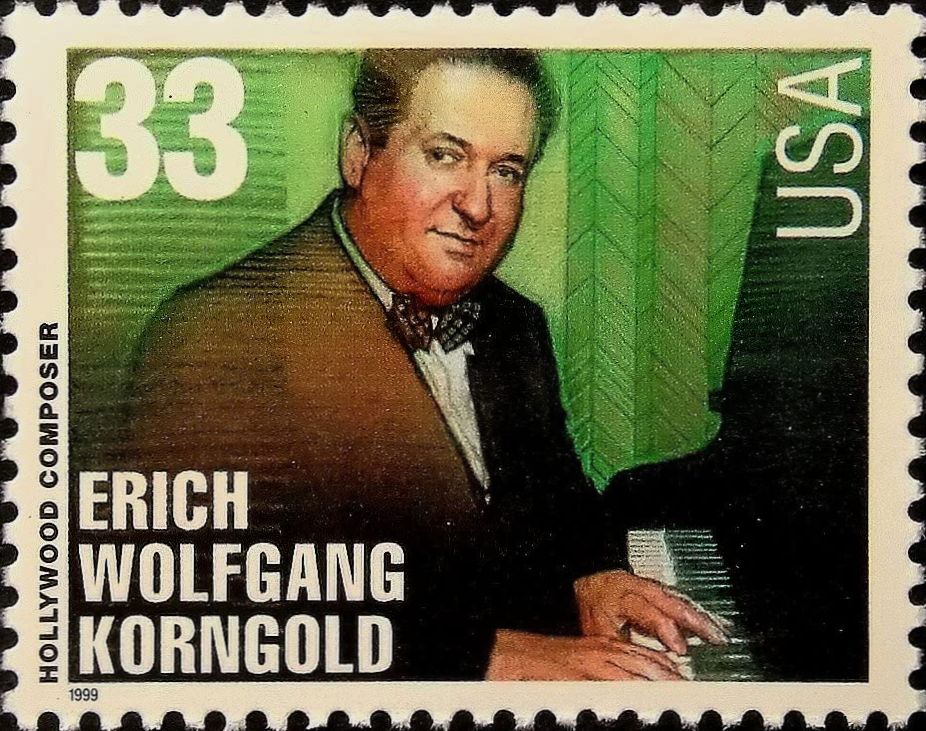
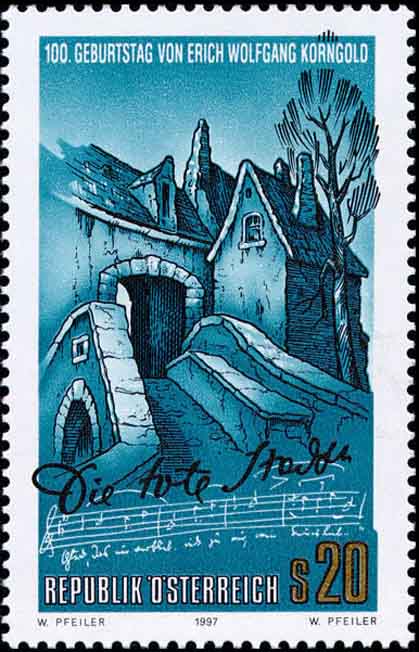
The Austrian composer Erich Wolfgang Korngold was born on May 29, 1897 in Brno, he died on November 29, 1957 in Los Angeles. May 2022 will be his 125th birthday.
Korngold was considered a musical prodigy in Vienna. As early as 1910, a ballet music by the 13-year-old was premiered at the Vienna Court Opera. Some of his early works were frequently performed by prominent conductors such as Bruno Walter,

USA 16.9.1999

Austria 31.3.1997
Erich Wolfgang Korngold considered himself a representative of modern classicism. In addition to film music and six operas, his compositional output includes piano works, songs, orchestral and chamber music, choral works, incidental music and an operetta.
The video shows Jeffrey Schindler and the Australian International Symphony Orchestra Institute performing the overture to the 1940 film “The Sea Hawk” by Erich Wolfgang Korngold. The recording was made in 2010 during the final concert of the summer course at the University of Tasmania’s Conservatory of Music.
Stamp of the Month: April 2022
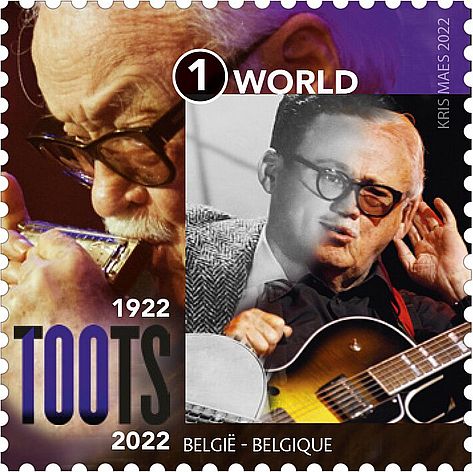
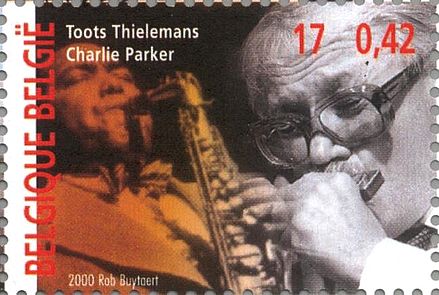
The Belgian jazz musician Jean-Baptiste Frédéric Isidor Thielemans was born on April 29, 1922 in Brussels. He died in his hometown on August 22, 2016. April 2022 will be his 100th birthday.
Under his stage name “Toots” Thielemans was an outstanding representative of modern jazz. He learned to play the accordion and guitar and eventually discovered the chromatic harmonica.
Belgium 21.3.2022
In 2004, Toots Thielemans was honored with the German Jazz Trophy for his life’s work, and in 2009 he received the NEA Jazz Masters Fellowship, the highest award for jazz musicians in the USA. In 2001, King Albert II of Belgium made him a baron.
Belgium 18.11.2000
The video shows Toots Thielemans at the “Night of the Proms” 2009 in Rotterdam. He performs his jazz standard “Bluesette”. This title was composed and first recorded in 1961 and has since been covered by more than 100 artists.
Stamp of the Month: March 2022

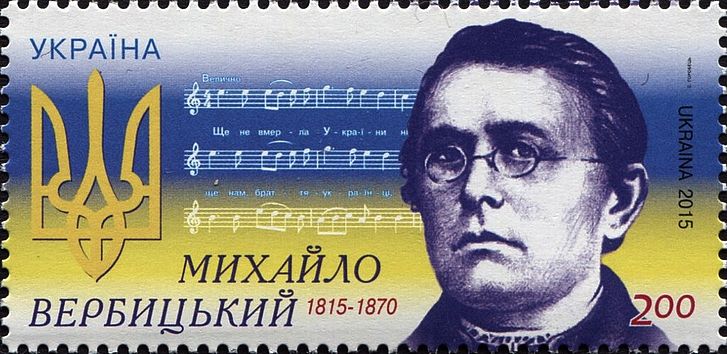
Ukraine 4.3.2015
Shche ne vmerla Ukrainy i slava, i volia
(Ukraine hasn’t parished yet, nor her glory, nor her freedom)
In the autumn of 1862, long before Ukraine existed as an independent state, the Ukrainian poet Pavlo Chubynsky, wrote the patriotic poem “Never perished is Ukraine’s glory and freedom”. The background was the revival movement of the Slavic peoples under foreign rule. The poem quickly spread and resulted in Chubynsky being placed under police surveillance “because of his harmful influence on people’s minds” and being resettled in Arkhangelsk. In 1863, the poem was first published in the Lviv magazine “Мета”. The Catholic priest and composer Mykhailo Verbytsky, was so enthusiastic about the text that he first composed the singing part and later an orchestral accompaniment. In 1865 the poem set to music was published with sheet music.
In 1917 the anthem was sung as the national anthem of the young Ukrainian People’s Republic; however, during the period of brief independence between 1917 and 1920, it was not officially designated as the state anthem.
After the collapse of the Soviet Union and the founding of an independent Ukraine, Verbytsky’s music was written into the constitution as an anthem in 1991. The words to be sung were laid down by law in 2003. The original text of the first line “Never perished is Ukraine’s glory and freedom” was changed by a small grammatical correction and now reads: “Ukraine hasn’t parished yet, nor her glory, nor her freedom”.
Ukraine hasn’t parished yet, nor her glory, nor her freedom.
Upon us, fellow kin, fate shall smile once more.
Our enemies will vanish, like dew in the morning sun,
And we too shall rule, brothers, in a free land of our own.
We’ll lay down our souls and bodies to attain our freedom,
And we’ll show that we, brothers, are of the Kozak nation.
Stamp of the Month: February 2022

Belgium 21.1.2006
The stamp depicts a posthumous miniature from 1523 showing Johannes Ockeghem as “premier chappellain” with his singers.
The singer and composer Johannes Ockeghem was born between 1420 and 1425 in Saint-Ghislain in Belgium. He died in Tours on February 6, 1497. February 2022 marks the 525th anniversary of his death.
Ockeghem probably received his musical training at the Saint-Germain collegiate church in Mons. He is personally documented for the first time in 1443 as the first of seven chapel singers at the court of Duke Charles I of Bourbon. From 1451 he was a singer in the court orchestra of the French king Charles VII. Numerous documents show that he held this position for more than 40 years, even during the reigns of the two following kings Louis XI. and Charles VIII of France. In parallel with his duties at court, Ockeghem was appointed by the king in 1459 as treasurer of the church of
Johannes Ockeghem is considered one of the most important composers of the early Renaissance. He was the first composer to devote special attention to the cyclic chants of the mass. His Requiem is the first complete setting of the requiem mass and he was probably the first giving the bass part in vocal music the importance it retained for the next 400 years. His compositions – numerous masses, motets and other sacred and secular works – show a remarkable stylistic range. Particularly noteworthy is his contrapuntal ability, which astonished connoisseurs such as Erasmus of Rotterdam even during his lifetime. For example, among the works by Ockeghem that have been proven to be lost is a 36-part motet (hardly any work by other 15th-century composers has more than 15 parts). In his works, Johannes Ockeghem developed the polyphonic style of Franco-Flemish music into the classical vocal polyphony that has shaped European music for more than a century.
The video shows a performance of Johannes Ockeghem’s “Ave Maria” at the Chelsea Music Festival at St. Paul’s German Lutheran Church, New York City, on June 8, 2019. The “Ghostlight Chorus” is a New York chamber choir founded in 2010 by conductor Evelyn Troester DeGraf.
In Memoriam: Elza Soares

Stamp of the Month: January 2022

USA 10.9.1997

Nicaragua 22.1.1975
American opera singer Rosa Ponselle was born on January 22, 1897 in Meriden, Connecticut, and died on May 25, 1981 in Baltimore, Maryland. January 2022 will mark her 125th birthday.
Rosa Ponselle (actually Rosa Melba Ponzillo) appeared from 1915 with her older sister Carmela as the Ponzillo Sisters in New York cinemas and cabarets. The impresario William Thorner recognized her talent and brought her into contact with the Metropolitan Opera, where she was promoted by Enrico Caruso. In 1918 she made her stage debut alongside Caruso as Leonore in “La forza del destino” by Giuseppe Verdi. The performance made Ponselle famous overnight. From 1918 to 1937 she was part of the Met ensemble for 19 seasons in a row.
After the end of her active career, she took on a managerial position at the newly founded Baltimore Civic Opera. There she also gave singing lessons. One of her students was Plácido Domingo.
Stamp of the Month: December 2021

Austria 23.2.2004
The Catalan opera singer Josep Maria Carreras i Coll (Spanish form: José Carreras) was born on December 5, 1946 in Barcelona. He will celebrate his 75th birthday in December 2021.
In 1963 Carreras broke off his chemistry studies and began to study singing at the Conservatori Superior de Música in Barcelona. In 1970 he made his debut at the Gran Teatre del Liceu there in Verdi’s „Nabucco“.
In May 2009 Carreras announced his retirement from the opera stage, but continued to give concerts and celebrated a triumphant comeback on the opera stage in Bilbao in 2014 with the world premiere of Christian Kolonovits’ opera “El Juez”. José Carreras, one of the outstanding tenors of the second half of the 20th century, celebrated his departure from the Vienna State Opera at a gala in September 2021.

At the height of his career, Carreras fell ill with leukemia in 1987. Despite a bad prognosis, he was able to resume his singing career after a bone marrow transplant, which was hardly widespread at the time. Out of gratitude for the medical help, he founded the José Carreras Leukemia Foundation in 1988, for which he has raised over 200 million euros with benefit galas over the past twenty years.