Category: Stamps

50 Years ago …

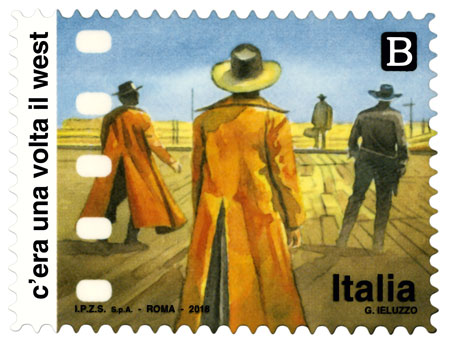
On August 14, 1969, the movie “Once Upon a Time in the West” started in German cinemas,
to which Ennio Moriccone has composed one of the most famous film scores.


Italy 6.9.2018


The music is an essential part of Italo-Western “Once Upon a Time in the West” (Original title: C’era una volta il West) directed by Sergio Leone in 1968. The music was completed by Ennio Moricone before the filming began. Sergio Leone then staged entire passages of the film to the rhythm of the music. The almost operatic music was at that time completely uncommon for a film music and especially for the Western genre. Each main character has its own musical theme, which is repeatedly taken up as a leitmotif. The plaintive harmonica (originally played by Franco de Gemini) is the key to understand the story, but it is only presented at the end of the movie. Especially convincing are the wordless vocals of the Italian singer Edda Dell’Orso for the female lead role.

Stamp of the Month: August 2019


Paraguay 5.8.1994
 
Agustín Pío Barrios

The Paraguayan composer Agustín Pío Barrios was born on 5 May 1885 in San Juan Bautista de las Misiones. He died on August 7, 1944 in San Salvador. August 2019 marks the 75th anniversary of his death.
Barrios was trained at the Instituto Paraguayo in Asunción. Already as a teenager he appeared as a guitarist and wrote piano pieces by Bach and Beethoven for guitar. In 1910 he undertook a concert tour to Argentina, which became such a great success that in the next two decades he toured almost all the countries of South and Central America and gave concerts there. In the 1920s, he turned increasingly to the culture of his homeland and played in his concerts transcriptions for guitar by Bach and other European composers as well as own compositions with Native American influences.
Agustín Pío Barrios is considered one of the first guitar virtuosos in South America. He was probably the first classical guitarist to record his own records and the first guitarist to play a complete Bach lute suite with the guitar at a public concert. Barrios composed around 300 own works. They are considered innovative in terms of their expressiveness and their romantic harmony and exploit the full potential of the guitar. Among guitarists, the works of Barrios have a similar meaning as the works of Chopin for the pianists.
 
The video shows the Croatian guitarist Ana Vidović (* 1980) with a movement from the composition “La Catedral” by Agustín Pío Barrios.


Stamp of the Month: July 2019


Israel 1.5.2019


Hava Nagila (English: “Let us be happy”) is an Israeli folk song that is sung to Jewish festivals. The melody is based on a Hasidic Nigun, a religious melody sung mostly without lyrics. When Hebrew was revived as a spoken language in Palestine in 1915, Abraham Zevi Idelsohn (1882-1938), professor at the Hebrew University, began cataloging all known Jewish compositions. The melody is attributed to the Sadigurer Khasidim, who lived in present-day Ukraine. The later cantor Moshe Nathanson (1899-1981), a student of Professor Idelsohn, was commissioned to write a text for the melody to make a modern Hebrew song. The song is mostly danced as circle dance (hora) with any number of people.

Stamp of the Month: June 2019


Monaco 20.6.2019
 
Jacques Offenbach

The German-French composer Jakob “Jacques” Offenbach was born on 20 June 1819 in Cologne. He died on October 5, 1880 in Paris. In June 2019, his birthday marks the 200th anniversary.
Offenbach received his first cello and violin lessons from his father. From 1830 he appeared in Cologne together with two of his siblings as a trio to earn money for music lessons. In 1833 he enrolled in the cello class of Olive-Charlier Vaslin at the Paris Conservatoire national de Musique. In 1835 he began as a cellist at the Opéra-Comique and received composition lessons with Jacques Fromental Halévy from 1837.
Offenbach initially composed smaller romances, waltzes and salon pieces. In 1849 he got a job as Kapellmeister at the Paris Théâtre-Français. Incidentally, he made a name for himself as an outstanding cello virtuoso and played among others with Anton Rubinstein, Franz Liszt and Felix Mendelssohn Bartholdy. On the occasion of the World Exhibition in Paris 1855, Offenbach opened his own theater where he premiered several of his operettas.
Offenbach composed 75 pieces for violoncello and 102 stage works. His most famous operettas include “The Beautiful Helen”, “Bluebeard”, “Parisian Life” and “Orpheus in the Underworld” with the famous “Cancan”. In his works, he combined lively, catchy music with a satirical-profound plot with allusions to the customs, people and events of his time.
From 1877 he concentrated on the composition of his last work “The Tales of Hoffmann”, whose premiere on February 10, 1881 in the Opéra-Comique, he unfortunately could not live.
 
The video shows Anna Netrebko and Elīna Garanča with the “Barcarole” from Offenbach’s “The Tales of Hoffmann”. Emmanuel Villaume conducts the Prague Philharmonic Orchestra.


France 14.2.1981


Benin 15.12.1980

Benin 15.12.1980

Benin 2000

Congo 5.7.1980

Monaco 12.11.1979

Chad 2000

Gabon 14.4.1980

In memoriam: Doris Day


On May 13, 2019, the American actress and singer Doris Day died at the age of 97 years. Born on April 3, 1922 in Cincinnati, she first appeared as a singer of various big bands. Her breakthrough came in 1944 with the number one hit “Sentimental Journey”. In 1947 she made the leap to Hollywood, where she was seen in a series of musicals and music films in the 1950s and early 1960s. Over the course of her career, Doris Day has placed more than 50 hits in the charts, including such well-known songs as “Que Sera, Sera (Whatever Will Be, Will Be)” and “Fly Me to the Moon”. Several times she worked as a singer with Frank Sinatra, Dinah Shore, Harry James and Frankie Lee.
 

Stamp of the Month: May 2019


Romania 28.3.1985
 
Stanisław Moniuszko

The Polish composer, conductor and music educator Stanislaw Moniuszko was born on May 5, 1819 in Ubiel near Minsk (now Belarus). He died on June 4, 1872 in Warsaw. May 2019 marks his 200th birth anniversary.
 
Moniuszko’s family belonged to impoverished Polish gentry and lived in Warsaw from 1827. From 1937 he studied in Berlin for three years and then earned for living as an organist and piano teacher in Vilnius.

In 1847, the first version of his opera “Halka” was listed on the Warsaw State Opera, but was banned immediately after the premiere because of their sharp social criticism. Only 11 years later, on 1 January 1858 it was followed by the second performance, which was a resounding success and is considered the birth of the Polish National Opera. On two trips through Europe, Moniuszko made contact with Liszt, Smetana, Gounod and Rossini. After his return, he was offered the Head of the Warsaw Opera, which he held until his death.
Except of 24 operas and operettas, Moniuszko’s work covers about 300 songs. In its simplicity they document his common touch and his ability to musical poetry.

Poland 15.11.1972


The video shows the orchestra of the State Music School in Żagań under the direction of Ivan Moroz with the Mzurka from Stanislaw Moniuszko’s opera “Halka”.

Stamp of the Month: April 2019


USA 17.9.1994
 
Bessie Smith

The American blues singer Bessie Smith was born on April 15, 1894 in Chattanooga, Tennessee. She died on September 26, 1937 in Clarksdale, Mississippi. In April 2019, her birthday marks the 125th anniversary.
 
After the early death of her parents, she joined a traveling vaudeville theater, where she performed as a singer and dancer. There she met the singer Ma Rainey, who took care of her and helped her to the first solid engagements. After appearances with the Charlie Johnson Orchestra in the elegant dance hall “Paradise Gardens” in Atlantic City, Bessie Smith made her first recordings in 1923, including the title “Down Hearted Blues”, which eventually made her famous.

The song was the No. 1 of the Billboard Charts for four weeks; in seven months 870,000 copies were sold. With her passionate voice, Bessie Smith was an attraction in many clubs, music halls, and radio shows until the late 1920s. She also appeared with Louis Armstrong and other famous musicians.
Bessie Smith, the “Empress of the Blues”, recorded more than 150 records. In 1980 she was inducted into the Blues Hall of Fame and in 1984 in the National Women’s Hall of Fame.
 
 
Listen to Bessie Smith (vocal) and Clarence Williams (Piano) performing their first hit “Down Hearted Blues” of 1923.


Stamp of the Month: March 2019


Russia 20.1.1994
Nikolai Andreyevich Rimsky-Korsakov

The Russian composer Nikolai Rimsky-Korsakov was born in Tikhvin on 18 March, 1844. He died on June 21, 1908 near Luga / St Petersburg. In March 2019, his birthday marks the 175th time.
 
Rimsky-Korsakov’s musical talent was early recognized and encouraged. In 1859, his piano teacher introduced him to the composers Balakirev and Cui. They encouraged him to compose his first work. After his military service Rimsky-Korsakov was mainly involved with Russian folk music and ancient Russian traditions, which he incorporated into his works.
In 1871 he became professor of orchestration and composition at the St Petersburg Conservatory and from 1874 to 1881 he was director of the Free School of Music. Due to his academic position, he became the most influential representative of “The Mighty Handful”. His students included, among others, Glazunov, Stravinsky and Prokofiev and his influence is also felt in some orchestral works of Ravel, Debussy, Dukas and Respighi.
Rimsky-Korsakov composed 15 operas, several orchestral works, choral works, chamber music, piano music and songs.
 

The video shows the violinist David Garrett on a recital of the orchestral piece “Flight of the Bumblebee” from the opera “The Tale of Tsar Saltan” by Nikolai Rimsky-Korsakov, taken in Saarbrücken on May 8, 2016.