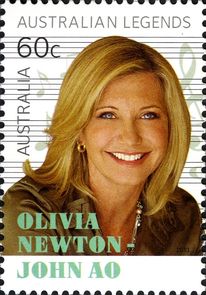
The British-Australian singer, songwriter and actress Olivia Newton-John died on August 8, 2022 in Santa Ynez Valley, California.
Newton-John was born on September 26, 1948 in Cambridge. In 1955 the family moved to Australia. Already as a schoolgirl she won several singing competitions, founded a girls group and got her first record deal in 1966. With her country, folk, pop and disco songs, she was one of the biggest stars of the 1970s and early 1980s. Between 1973 and 1983 she received 4 Grammys and 9 American Music Awards.
Over the course of her long career, Olivia Newton-John has sold more than 100 million records, making her one of the top-selling artists worldwide to date. Her most successful release is the soundtrack album for the musical film Grease, in which she starred alongside John Travolta.
In addition to numerous other awards, Olivia Newton John was made an officer by Queen Elizabeth II in 1979 and made a Dame Commander of the Order of the British Empire in 2020.
After being diagnosed with breast cancer in 1992, Newton-John went public to share her cancer. She supported numerous charity projects and founded a foundation for cancer research, with the help of which the Olivia Newton-John Canver Wellness & Research Center was opened in Melbourne in 2012.
The video features Olivia Newton-John performing one of her biggest hit singles, “Physical.” This song spent ten weeks at number one in the US single charts in late 1981, making it the longest number one single of the 1980s.
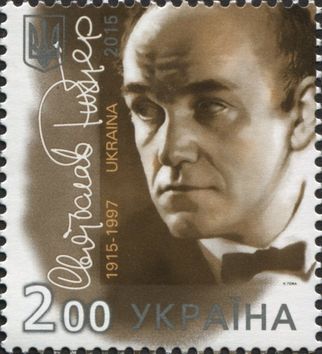
The Ukrainian pianist Sviatoslav Teofilowitsch Richter was born on March 20, 1915 in Zhitomir (Russian Empire, today Ukraine). He died 25 years ago, on August 1, 1997 in Moscow.
Richter’s father was a German-born pianist who took a job as an organist and choirmaster in Odessa in 1916. From the age of three he ensured that his son received a solid musical education.
Ukraine 20.3.2015
Aged 15, Richter became a répétiteur at the Odessa Opera House, 1935 he made his debut as a pianist. From 1937 he attended a piano master class at the Moscow Conservatory. In Moscow Sviatoslav Richter met Sergei Prokofiev, whose 6th Sonata he premiered in 1942. The world premieres of the 7th and 9th sonatas, dedicated to Richter, followed later. In 1960 Richter was allowed to travel to the West for the first time. The debut on October 19, 1960 in Carnegie Hall in New York was followed by a major US tour.
Richter’s recordings of the works of Tchaikovsky, Schubert, Schumann, Liszt and the Well-Tempered Clavier by Johann Sebastian Bach are legendary. His Préludes by Rachmaninoff are still considered a kind of reference recording today.
In addition to his solo activities, Sviatoslav Richter also played chamber music with, among others, David Oistrakh, Pierre Fournier, Mstislav Rostropovich and Benjamin Britten.
The video shows Sviatoslav Richter performing Mozart’s Piano Sonatas No.4 in E flat major (K282), No.16 in C major (K545) and No.8 in A minor (K310) live recorded at the Barbican Centre, London, 29 March 1989.
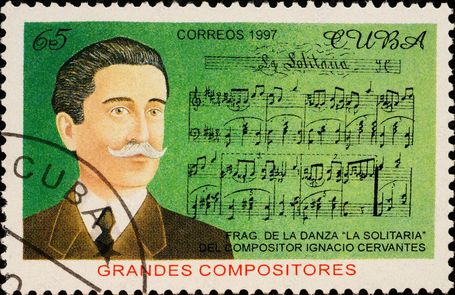
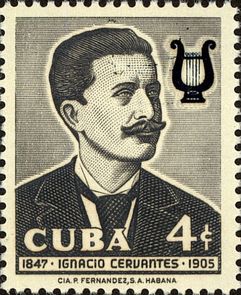
The Cuban pianist and composer Ignacio Cervantes Kawanag was born on July 31, 1847 in Havana. He died in his hometown on April 29, 1905. July 2022 will be his 175th birthday.
Cuba 15.9.1997
Cuba 27.6.1959
Cervantes was considered a child prodigy and was taught by the American composer Louis Moreau Gottschalk, among others. Gottschalk encouraged him to study at the Conservatoire de Paris (1866-1870), where he received first prizes for composition (1866) and harmony (1867) and gave concerts with Christina Nilsson and Adelina Patti.
Cervantes was one of the first musicians to emphasize the special character of the Central and South American peoples in their music.
As a supporter of the Cuban rebels, he had to leave the country temporarily in 1875 and lived in Mexico and the United States for several years. Ignacio Cervantes composed an opera, various pieces of chamber music, zarzuelas and the famous forty-one “Danzas Cubanas”. He wrote his “Fusión de Almas” for his daughter María Cervantes (1885-1981), who became a well-known pianist, composer and singer.
The video shows the Orquestra De Guiarres De Barcelona conducted by Sergi Vicente performing a medley of Ignacio Cervantes’ “Danzas Cubanas”. All members of the orchestra are teachers, graduates or master students of the Conservatorio Superior de Mùsica del Liceo in Barcelona.
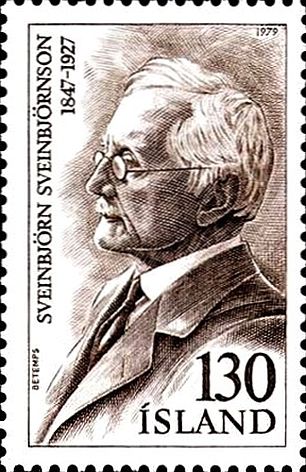
The Icelandic composer Sveinbjörn Sveinbjörnsson was born on June 28, 1847 in Seltjarnarnes, he died on February 2, 1927 in Copenhagen. June 2022 will be his 175th birthday.
Sveinbjörnsson showed musical talent from an early age. However, since his father died early and a career as a professional musician in Iceland was practically impossible at the time, he trained as a pastor. In 1868 he decided to study music, majoring in piano and harmony. He was a member of the choir of Niels Gade’s music association and took piano lessons from Carl Reinecke in Leipzig in 1872/73. From 1873 to 1919 he lived in Edinburgh as a pianist and music teacher.
Island 11.12.1979
In addition to a number of choral works, Sveinbjörn Sveinbjörnsson’s compositional oeuvre mainly includes piano and chamber music, which reveals a clear connection to the British salon music of the time. As early as 1874 he composed the melody of the later Icelandic national anthem “Lofsöngur” to the text by the poet Matthías Jochumsson. Icelandic music is rarely found in his work, e.g. in the two “Icelandic Rhapsodies”, in which he combined melodies from Icelandic folklore into one piece of music.
The video shows the Icelandic pianist Nína Margrét Grímsdóttir (*1965) with Sveinbjörn Sveinbjörnsson’s “Minuet & Trio” from 1873, the first musical work composed by an Icelander. The recording was made in March 2011 at the Icelandic Music Museum in Kópavogur.
The British musician Andrew Fletcher died on May 26, 2022.
Andrew Fletcher was born in Nottingham on July 8, 1961. He first played electric bass and was a member of the group “No Romance in China” with his school friend Vince Clarke. In 1979 he switched to synthesizers and formed the band “Composition of Sound” together with Clarke and Martin Gore. The band was later renamed “Depeche Mode”.
“Depeche Mode” is considered the most popular synth rock and synth pop group. With over 100 million records sold worldwide, it is one of the most successful bands in the world. Andrew Fletcher was the only member of the band who never wrote a song. As the band’s keyboardist, however, he had a decisive influence on the band’s style. In addition, he took on many of the organizational tasks and was heavily involved in the band’s studio work.
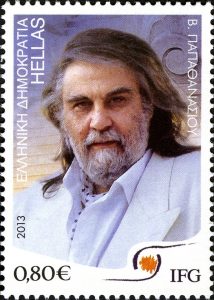
On May 17, 2022, the Greek composer Evangelos Odysseas Papathanassiou, better known by his stage name Vangelis, died in Paris at the age of 79 as a result of a COVID-19 disease. Born on March 29th, 1943 in Agria, Greece, Vangelis was one of the pioneers of electronic music. Vangelis was largely self-taught in music and had only a basic knowledge of reading or writing music throughout his career. In the early 1960s he founded his first band. In 1968 he formed the progressive rock group Aphrodite’s Child with Demis Roussos and Lucas Sideras, which had several hit singles. In 1973 he started his solo career with his first film scores. In the 1980s he shared several international hits with Jon Andersen. In 1982 Vangelis won the first Oscar for an all-synthesizer film score with the music for the strip “Chariots of Fire”. Other film music hits followed, such as “Blade Runner”, “Bounty” and “1492 – Conquest of Paradise”, the background music for many documentaries by Jacques Cousteau, as well as the anthem for the 2002 World Cup.
Every year, worldwide more than 200 stamps related to music are issued. The list of new issues published in the members-only-section of our website is updated several times per month.
15.1.: Central African Republic / Chad / Mongolia / Mocambique / Tuvalu
6.3.: Angola / Central African Republic / Chad / Colombia / Djibouti / Mocambique / Sao Tomé / Togo / Turkmenistan
24.3.: Chad / Djibouti
13.4.: Albania / Central African Republic / Chad / Philippines / Uzbekistan
7.5.: Andorra / Guinea-Bissau / Paraguay / Sao Tomé
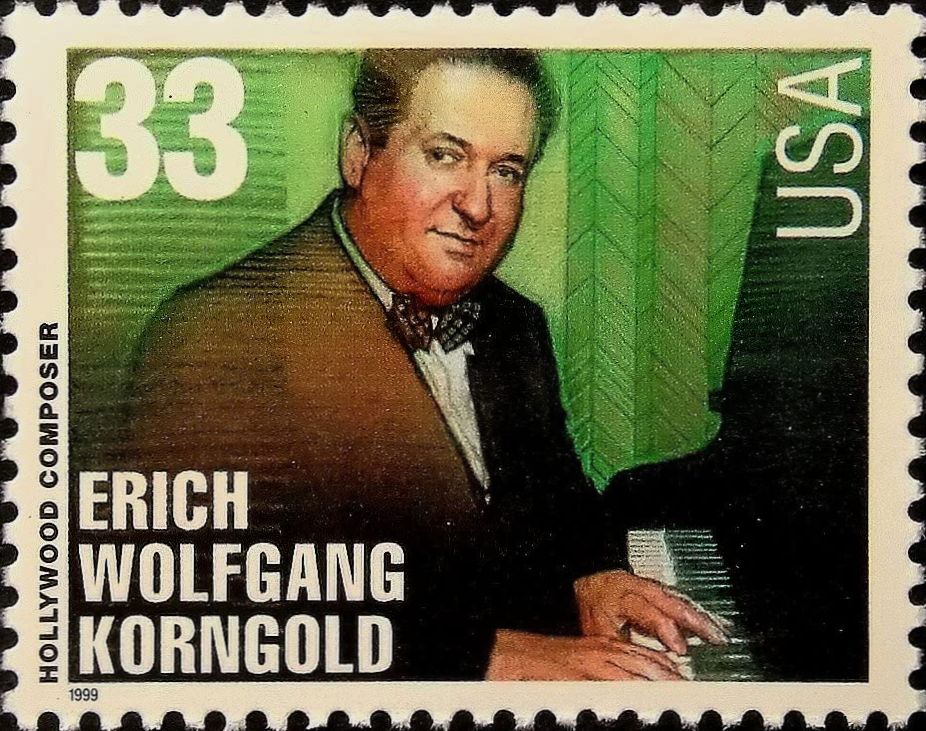
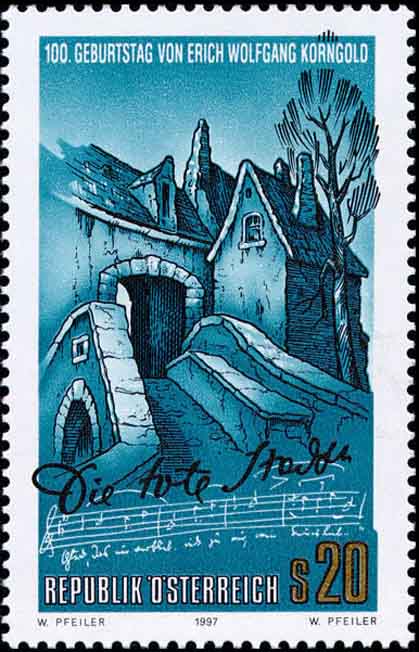
The Austrian composer Erich Wolfgang Korngold was born on May 29, 1897 in Brno, he died on November 29, 1957 in Los Angeles. May 2022 will be his 125th birthday.
Korngold was considered a musical prodigy in Vienna. As early as 1910, a ballet music by the 13-year-old was premiered at the Vienna Court Opera. Some of his early works were frequently performed by prominent conductors such as Bruno Walter,
USA 16.9.1999
Austria 31.3.1997
Arthur Nikisch, Wilhelm Furtwängler and Richard Strauss. Korngold’s operas “Der Ring des Polykrates”, “Violanta” (both 1916), “Die tote Stadt” (1920) and “Das Wunder der Heliane” (1927) were great successes and made him – alongside Richard Strauss – the most frequently performed opera composer in Germany and Austria. In 1934 he followed Max Reinhardt’s invitation to Hollywood to compose the film music for his film “A Midsummer Night’s Dream”. With the work on this film, in which a symphony orchestra was used for the first time, he set new standards in the still young history of film music. Because of his Jewish heritage, he stayed in the United States and worked as a film composer for Warner Brothers. By 1946 he had composed the music for
19 films, of which “Anthony Adverse” (1936) and “The Adventures of Robin Hood” (1938) each received an Oscar for the best film score.
Erich Wolfgang Korngold considered himself a representative of modern classicism. In addition to film music and six operas, his compositional output includes piano works, songs, orchestral and chamber music, choral works, incidental music and an operetta.
The video shows Jeffrey Schindler and the Australian International Symphony Orchestra Institute performing the overture to the 1940 film “The Sea Hawk” by Erich Wolfgang Korngold. The recording was made in 2010 during the final concert of the summer course at the University of Tasmania’s Conservatory of Music.
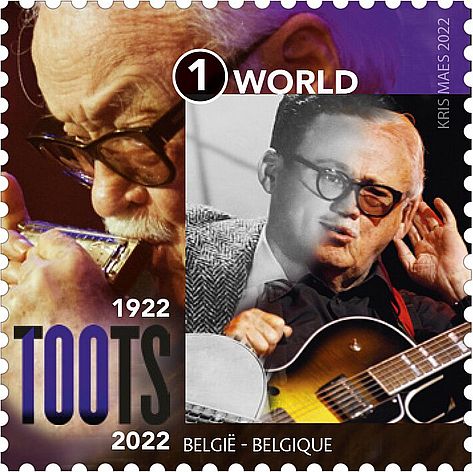
The Belgian jazz musician Jean-Baptiste Frédéric Isidor Thielemans was born on April 29, 1922 in Brussels. He died in his hometown on August 22, 2016. April 2022 will be his 100th birthday.
Under his stage name “Toots” Thielemans was an outstanding representative of modern jazz. He learned to play the accordion and guitar and eventually discovered the chromatic harmonica.
Belgium 21.3.2022
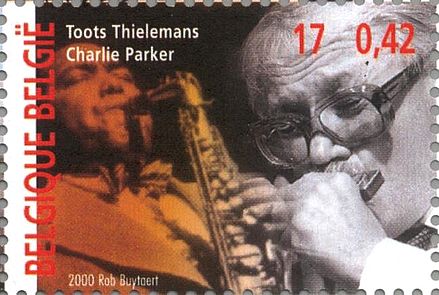
Like no other, he helped the harmonica to gain respect in jazz. As early as 1950 he was a member of the “All-Star Band” on Benny Goodman’s European tour. Later he made music with, among others, Charlie Parker, Bill Evans, Ella Fitzgerald, Quincy Jones, Paul Simon and Billy Joel. In the 1980s he was a frequent member of the all-star cast around Dizzy Gillespie. He can also be heard with his instrument in the soundtrack of several film scores such as “Asphalt Cowboy”, “The Getaway” or “French Kiss”.
One of his most famous works as a composer is the background music for the children’s television series “Sesame Street”.
In 2004, Toots Thielemans was honored with the German Jazz Trophy for his life’s work, and in 2009 he received the NEA Jazz Masters Fellowship, the highest award for jazz musicians in the USA. In 2001, King Albert II of Belgium made him a baron.
Belgium 18.11.2000
The video shows Toots Thielemans at the “Night of the Proms” 2009 in Rotterdam. He performs his jazz standard “Bluesette”. This title was composed and first recorded in 1961 and has since been covered by more than 100 artists.
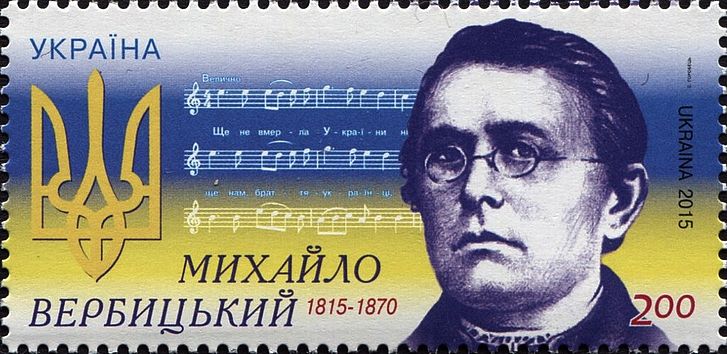
Shche ne vmerla Ukrainy i slava, i volia
(Ukraine hasn’t parished yet, nor her glory, nor her freedom)
In the autumn of 1862, long before Ukraine existed as an independent state, the Ukrainian poet Pavlo Chubynsky, wrote the patriotic poem “Never perished is Ukraine’s glory and freedom”. The background was the revival movement of the Slavic peoples under foreign rule. The poem quickly spread and resulted in Chubynsky being placed under police surveillance “because of his harmful influence on people’s minds” and being resettled in Arkhangelsk. In 1863, the poem was first published in the Lviv magazine “Мета”. The Catholic priest and composer Mykhailo Verbytsky, was so enthusiastic about the text that he first composed the singing part and later an orchestral accompaniment. In 1865 the poem set to music was published with sheet music.
In 1917 the anthem was sung as the national anthem of the young Ukrainian People’s Republic; however, during the period of brief independence between 1917 and 1920, it was not officially designated as the state anthem.
After the collapse of the Soviet Union and the founding of an independent Ukraine, Verbytsky’s music was written into the constitution as an anthem in 1991. The words to be sung were laid down by law in 2003. The original text of the first line “Never perished is Ukraine’s glory and freedom” was changed by a small grammatical correction and now reads: “Ukraine hasn’t parished yet, nor her glory, nor her freedom”.
Ukraine hasn’t parished yet, nor her glory, nor her freedom.
Upon us, fellow kin, fate shall smile once more.
Our enemies will vanish, like dew in the morning sun,
And we too shall rule, brothers, in a free land of our own.
We’ll lay down our souls and bodies to attain our freedom,
And we’ll show that we, brothers, are of the Kozak nation.